Handwritten Mail for Nonprofits
We were writing donor mail before we built machines.
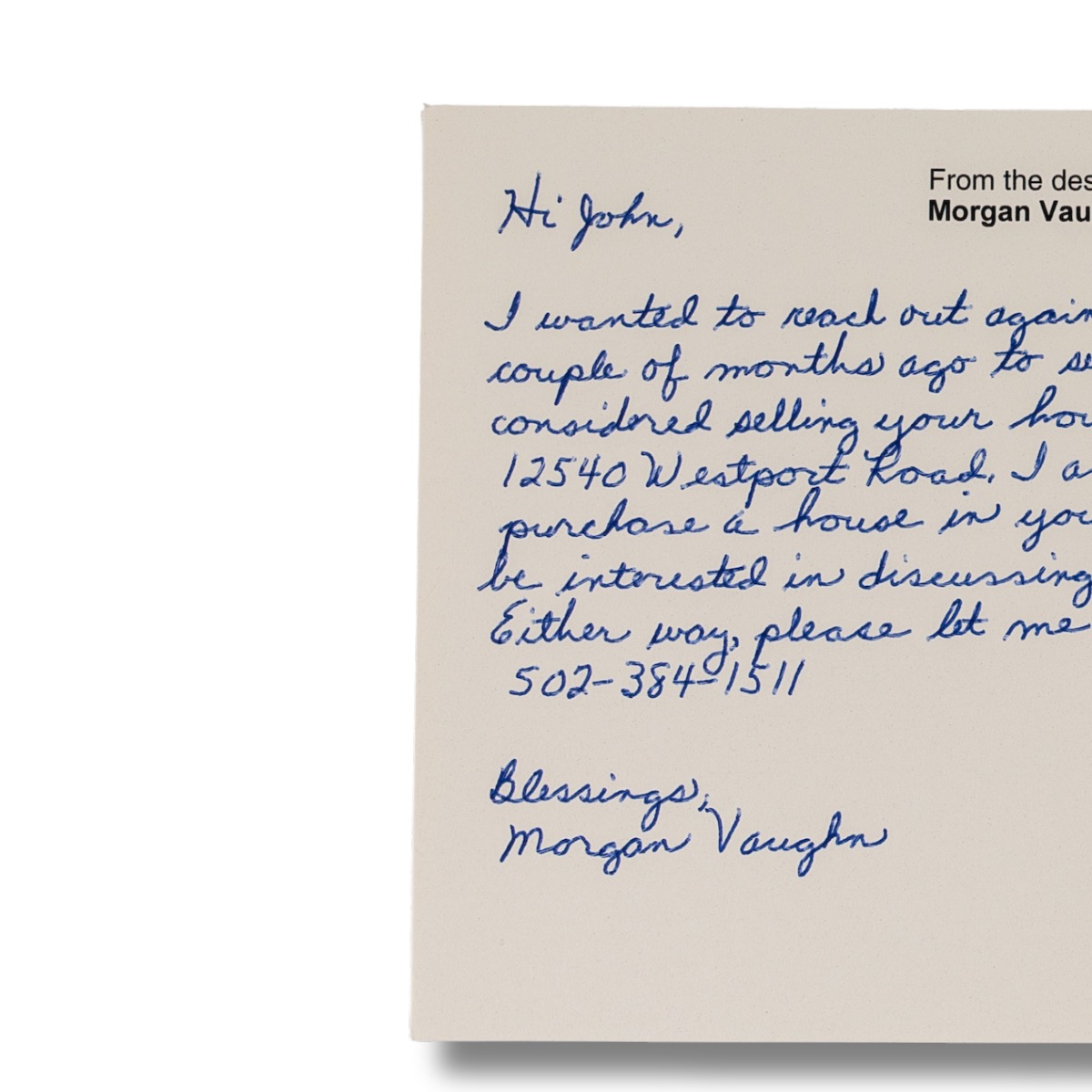
Pen Point's family history starts in nonprofit fundraising — decades of handwritten donor campaigns before a single machine existed. That's why the UniProd handles the most complex packages in mail, and why development teams are still the operators we understand best.
The track record
Numbers from three decades of donor mail.
historic response on handwritten appeals to high-donor lists
above the average mail piece — donation round-up returns on handwritten campaigns
of the family's handwritten fundraising mail, from garage to machine fleet
The full story is in The Family Behind the Handwritten Mail Industry. The short version: before Pen Point built handwriting machines, it ran the campaigns — so the machine was designed around what donor mail actually requires.
Where development teams point the pen
Six programs, one machine.
Donor thank-yous
Every gift answered with real ink, within days. The thank-you is the cheapest retention tool in fundraising — and the handwritten one is the version donors keep.
Year-end appeals
The December letter that has to outperform every other December letter in the pile. Handwritten envelopes and salutations are how high-donor appeals earn the open.
Event invitations
Galas, campaign kickoffs, donor dinners. A handwritten invitation sets the event's tone before anyone reads the date.
Volunteer recruitment & recognition
The people who give time respond to the same signal as the people who give money: someone took the time to write.
Donor anniversaries & milestones
Five years of giving, a lifetime total crossed, a first monthly gift. Variable fields let the machine mark each donor's actual milestone, in pen.
Complex appeal packages
Nonprofit mail is the most complex in the industry — reply envelopes, trifolds, inserts, note cards. The machine writes on stock from 60 to 300+ gsm, sizes 3×5 to 10×15, so the whole package can carry handwriting.
The calendar problem
Fundraising peaks in December. Plan the pen in September.
Year-end giving compresses a huge share of annual revenue into six weeks, and every organization's appeal lands in the same crowded mailbox. The machine's job is to make your envelope the one that gets opened — but only if the capacity exists when the list is ready.
At 100–110 envelopes per hour unattended, one UniProd covers most yearly programs comfortably. For a December spike, the rental fleet is the pressure valve: bring in a machine for the season at $1,000/month unlimited ($1,000 setup, 3-month minimum), and send it back in January.
Donor mail, answered.
Do handwritten appeals really out-pull printed ones?
On the right lists, dramatically. Our roots are in nonprofit mail: the family behind Pen Point spent decades running handwritten donor campaigns, with high-donor lists historically responding in the 25–30% range and donation round-up returns running 200–300% above the average mail piece. Printed mail doesn't get those numbers — the handwriting is the mechanism.
Is machine handwriting appropriate for donor mail?
It's real pen and real ink with human-sampled variation — not a font printed in gray. Donors respond to the care signal, and a machine lets a three-person development office send the volume of a fifty-writer operation without the handwriting becoming anyone's full-time job.
How do we handle the year-end crush?
Plan capacity in the fall. One machine writes 100–110 envelopes per hour unattended — rated up to 16,500 envelopes a month at continuous operation, with 10,000+ a realistic benchmark. Organizations with a December spike often rent a second machine for the season ($1,000/month unlimited, with a $1,000 setup fee and 3-month minimum) instead of buying for a peak.
What does it cost per piece compared to outsourcing?
Outsourced handwritten mail runs $2–5 per piece — workable for a one-off appeal, brutal at annual-campaign volume. In-house, your marginal cost is pens, stock, and postage. The cost comparison worth reading before budget season: machine vs outsourcing vs manual.
Full cost breakdown: machine vs outsourcing vs manual.