Handwritten Mail for Real Estate
The listing goes to the agent who wrote.
Real estate is the single biggest industry we serve — agents, brokers, and investors who figured out that in a mailbox full of printed postcards, the envelope with real ink is the one that gets opened. Here's how they run it.
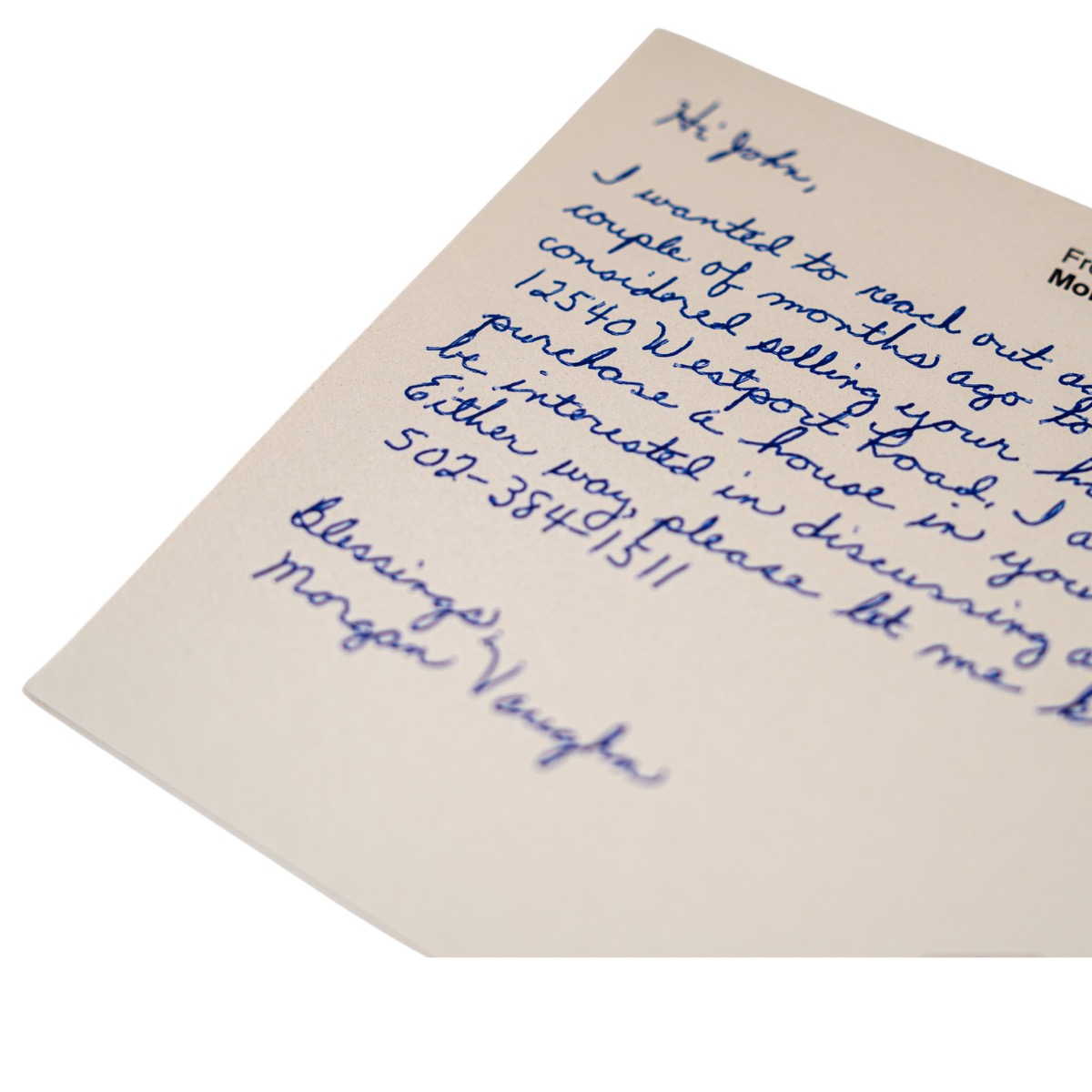
Six plays that fill a pipeline
What agents and investors actually run.
Farm-area letters
A monthly handwritten letter to the 300–500 homes you farm. Printed postcards from three other agents hit the same mailbox — yours is the one that gets opened, because it looks like it came from a neighbor.
Just-listed / just-sold notes
When a listing goes live or closes, the surrounding streets get a short handwritten note the same week. It's the difference between announcing a sale and starting fifteen conversations about one.
Post-closing thank-yous
A real-ink thank-you card lands in the first week after closing — when your client is still telling everyone about the move, and most likely to pass your name along.
Referral requests
Past clients answer handwritten mail that printed newsletters can't touch. A once-a-quarter personal note keeps you the agent they mention at dinner.
Seasonal touches
Home anniversaries, holidays, tax season. Variable fields mean every card carries their name, their street, their dates — written by pen, not printed to look like it.
Off-market acquisition letters
For investors: handwritten letters to absentee owners, tired landlords, and long-tenure households consistently outperform printed yellow letters that those owners have learned to ignore.
Why it works in this industry
Three structural advantages, one channel.
The audience reads its mail. Long-tenure homeowners — the people who own the listings, the equity, and the off-market deals — skew older, and they still open envelopes. A handwritten one doesn't just get opened; it gets kept on the counter.
The transaction justifies the piece. One commission pays for years of farm mail. Real estate is exactly the economics handwritten mail was made for: high transaction value, small targetable audience, relationship-driven decision.
The lists are targetable. MLS activity, ownership records, tenure, absentee status — you can name precisely who should get a letter and why. Handwritten mail rewards exactly that kind of aim, and punishes spray-and-pray.
Deeper dive: how investors build credibility with handwritten mail and what response rates to expect.
The math
A 500-home farm, in machine terms.
of machine time addresses a 500-piece monthly farm mailing — a few elevator loads, hands-free between them
per piece is what outsourced handwritten-letter services charge — every month, forever
rents it unlimited; $14,995 owns the machine outright with 3-year full coverage
The auto-feed elevator holds 150+ envelopes per load, so a farm mailing is stack-it-and-leave, not stand-and-feed. Full cost comparison: machine vs outsourcing vs manual.
From agents on our machines
What the phones sound like after a mailing.
“I got more listings off my first mailing with this than I ever did with printed mail.”
Sarah
Residential Realtor
“My phone is ringing off the hook every time I send these out.”
Michael
Luxury Real Estate Broker
“I've even had people call just to say thank you for the card.”
Robert
Real Estate Agent
An honest fit check
Who this isn't for.
If you close two deals a year and mail when you remember to, a machine is overkill — buy nice cards and write them yourself. The machine earns its keep when mail is a system: a farm touched monthly, every closing followed by a note, every investor list worked on a cadence. That's also the honest line between renting and buying — test the system at a monthly rental, then own it once the pipeline proves it.
Real estate mail, answered.
Do handwritten letters really work for real estate prospecting?
Yes — because the audience skews toward long-tenure homeowners who still read their mail, and because a real-ink envelope doesn't look like marketing. Handwritten envelopes are opened at rates printed mail can't reach, and typical prospecting campaigns see response in the 3–10% range depending on list quality — well beyond what printed mail typically pulls.
How many letters does an agent actually need to send?
A farm of 300–500 homes touched monthly is the classic cadence — 3,600–6,000 pieces a year. A UniProd writes 100–110 envelopes per hour unattended, so a month's farm mailing is an afternoon of machine time, not a week of hand-cramp.
Should I buy a machine or keep paying a handwritten-letter service?
Outsourced handwritten mail runs $2–5 per piece. In-house on a machine, your marginal cost is pens, paper, and postage. At farm-area volume the crossover comes fast — that's why teams and investors doing consistent mail bring it in-house, starting with a monthly rental or $14,995 to own.
What should the letters actually say?
Short beats long. Three to five sentences that read like a neighbor wrote them: who you are, one specific observation about their street or situation, and one low-pressure way to respond. The machine writes each one with your variable fields — name, street, date — in real pen, so a 500-piece run reads like 500 individual letters.